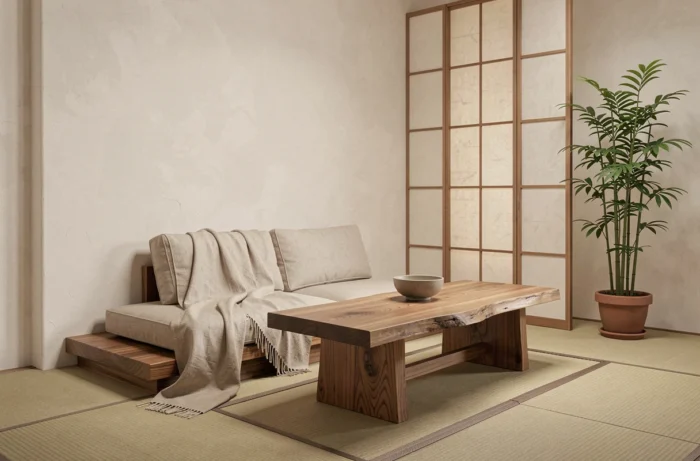
Creating a zen home is not just about placing a few candles on a shelf. The atmosphere of an interior depends on measurable parameters: noise level, air quality, perceived temperature, visual clutter. Each of these factors weighs differently depending on the room in question, and comparing them allows for prioritizing actions that truly change daily life.
Sound, thermal, and visual comfort: what matters room by room
Before choosing a wall color or furniture, it is useful to map out the actual sources of discomfort in each living space. The table below summarizes the factors that matter most according to the function of the room.
| Room | Priority Factor | Main Action Lever |
|---|---|---|
| Bedroom | Nighttime noise | Orientation, window seals, double glazing |
| Living Room | Visual clutter | Reducing furniture, closed storage |
| Kitchen | Air quality / odors | Effective ventilation, mechanical extraction |
| Office / Work Corner | Natural light | Positioning the work surface facing the window |
| Bathroom | Humidity | VMC, water-resistant materials |
This breakdown shows that a coherent zen approach does not treat all rooms the same way. The bedroom primarily requires work on acoustic calm, while the living room demands an effort to declutter.
The WHO sets a benchmark of 40 dB on average annually outside homes for nighttime noise. When one knows that a busy street far exceeds this threshold, the orientation of the bedroom and the state of the joinery become priority levers, well before the choice of calming bedding.
Ventilation and summer comfort: two often overlooked angles in zen decor
Articles on the zen home talk about plants, raw wood, feng shui. They rarely mention ventilation or the management of summer overheating, even though these two parameters directly condition the feeling of well-being in a space.
New homes subject to RE2020 include specific requirements for air renewal, verified upon completion of the construction site. In older homes, the situation is less regulated. Opening windows morning and evening remains the basic gesture, but a well-maintained VMC measurably changes indoor air quality, especially in humid rooms.
The ideas and resources compiled on the zenetdeco fr home site illustrate this holistic approach, where decorative layout is intertwined with functional choices like ventilation or solar protection.
RE2020 uses the “degree-hours” indicator to assess discomfort related to high heat. Passive solutions (shutters, solar screens, exterior blinds) help maintain a pleasant temperature without resorting to air conditioning. A living room exposed full west without solar protection will never be a relaxing space in July, regardless of the chosen color palette.
Natural light in the living room and office: balancing openness and overheating
Increasing natural light is a recurring piece of advice in zen decoration guides. The idea is correct but incomplete. A poorly oriented bay window brings as much heat as it does brightness, and the room becomes unlivable in the afternoon during summer.
The balance hinges on three points:
- The orientation of the room: a north or east exposure offers soft and constant light, ideal for an office or reading nook, without the risk of overheating
- The type of glazing: solar control double glazing reduces thermal gains while allowing visible light to pass through
- Exterior protections: adjustable slatted shutters or a solar screen allow modulation of light entry according to the time and season
Zen light is controlled light, not maximized light. Traditional feng shui also emphasizes the balance between well-lit areas and more subdued zones within the same living space.
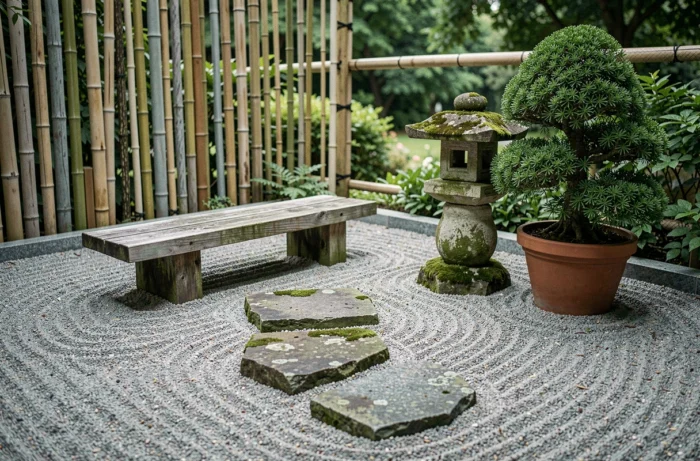
Decluttering the living room: beyond sorting, rethink circulation
Sorting belongings is the first reflex when trying to create a zen space. All guides recommend it, rightly so. The problem is that sorting is not enough if the furniture arrangement blocks circulation.
A living room where one has to navigate around a coffee table, step over a pouf, and skirt a too-large sofa generates a constant physical tension. The fluidity of movement in a room conditions the feeling of calm more than the number of objects present.
Some concrete principles work:
- Leave a passage at least the width of a person between each piece of furniture, without zigzagging
- Favor low furniture that does not obstruct the visual field and gives an impression of space
- Place closed storage along the walls to free up the center of the room
- Reduce the number of accent furniture (side tables, consoles, pedestals) that fragment the space
Minimalism applied to the living room does not mean living in emptiness. It is about keeping only the furniture that is used each week and positioning them so that the eye can move unobstructed from the threshold of the door to the window.
Ultimately, the layout of a zen home relies on both technical and decorative choices. The acoustics of the bedroom, the ventilation of the kitchen, the solar management of the living room, and the circulation in each room form a coherent whole. Addressing these four parameters as a priority yields more lasting results than changing the color palette or adding a few green plants.