
Organizing a wedding involves dozens of decisions, but not all have the same impact on the final budget or the flow of the big day. Before choosing a decoration or a playlist, two parameters determine the feasibility of the whole: the municipality of the ceremony and the administrative calendar. It is on these constraints that the difference between a smooth wedding and one hampered by delays is played out.
Administrative constraints and choice of municipality: what blocks before the reception venue
The majority of wedding guides start with the reception venue. The problem is that the civil ceremony can only take place in the municipality of residence or domicile of one of the future spouses, or in some cases in that of a parent. This framework is set by the Civil Code and reiterated by Service-Public (fact sheet updated in September 2026).
Booking a venue two hours away without checking the municipality’s administrative eligibility can force a separation between the civil ceremony and the reception. This implies two locations, two logistics, and sometimes two separate days.
The marriage file submitted to the town hall includes an identity document and proof of residence or domicile. The publication of the banns then imposes a minimum delay of ten days before the celebration. Any delay in compiling the file mechanically pushes back the possible wedding date.
Planning the wedding organization with 123 Mariages allows for structuring this administrative calendar alongside the search for the reception venue, without risking a mismatch between the two.
Wedding budget in France: where the expenses really go
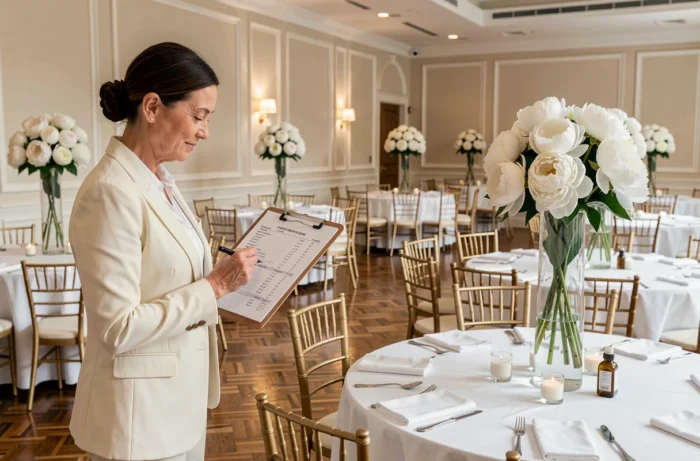
The gap between aspiration and reality remains significant for most couples. To understand where expenses are concentrated, a comparative table helps prioritize the items.
| Expense Item | Relative Share in the Budget | Negotiation Margin |
|---|---|---|
| Reception venue (rental + catering) | The heaviest, often half of the total | Low in high season, higher during the week or off-summer |
| Photographer / videographer | Intermediate item | Variable depending on the chosen package (half-day vs full day) |
| Decoration and flowers | Intermediate item | High (seasonal flowers, DIY, rental vs purchase) |
| Attire of the couple | Significant item | Moderate (second-hand, rental, custom-made) |
| Entertainment and music | Secondary item | High (DJ vs live band, self-managed playlist) |
The reception venue combined with catering represents the heaviest expense. In contrast, decoration remains the item where decisions yield the most visible savings, especially by prioritizing seasonal flowers in an eco-responsible approach.
Weather management on the big day: a protocol, not a backup plan
Recent professional feedback shows that the weather plan should function as an operational protocol, not as a vague fallback solution. A structured protocol relies on several concrete elements:
- Predefined triggering criteria (threshold probability of rain, wind strength), set with the venue manager
- An identified decision-maker, who is not one of the spouses, to make the call on the morning of the big day
- A quick alert system for guests (messaging group, dedicated phone) to adjust the timing or location of the outdoor ceremony
- A prior test of the backup setup (tent, indoor hall) to ensure that the capacity and catering logistics remain functional
Without this framework, the shift indoors happens in a rush. The stress generated affects the couple, the vendors, and the guests simultaneously.
Selection of wedding vendors: the filtering questions

Three filtering axes allow for quickly narrowing down a list of vendors:
- Actual availability on the desired date, with written confirmation and explicit cancellation conditions
- Experience at the chosen reception venue (a caterer familiar with the venue knows the access, storage, and timing constraints)
- Coordination among vendors on the big day (who manages the schedule, how communication occurs between the DJ, photographer, and caterer)
A vendor who already knows the venue significantly reduces logistical risks. This criterion often weighs more than the portfolio.
The question of coordination deserves special attention. A wedding planner is not justified solely by the time saved beforehand. Their role on the big day is to absorb the unexpected so that the couple does not have to make any operational decisions.
Guest list and reception: the decision that conditions everything else
The number of guests determines the venue, the caterer, the overall budget, and the format of the day. Each additional guest has a direct cost (meal, drink, furniture) and an indirect cost (size of the room, logistics, parking).
Reducing the list by ten people frees up a budget that can be redirected to a more experienced photographer or a better catering package. Conversely, adding a full table at the last minute compresses margins on all other items.
Setting the number of guests before visiting any venue prevents falling in love with a venue that is too small or defaulting to oversizing the reception. It is the decision that structures all the following ones.
The administrative file at the town hall, the realistic budget, the weather protocol, the vendor filter, and the number of guests form five interdependent levers. Adjusting one modifies the other four. Starting from these five parameters, rather than a decorative task list, provides a stronger decision-making framework for each step of the preparations.