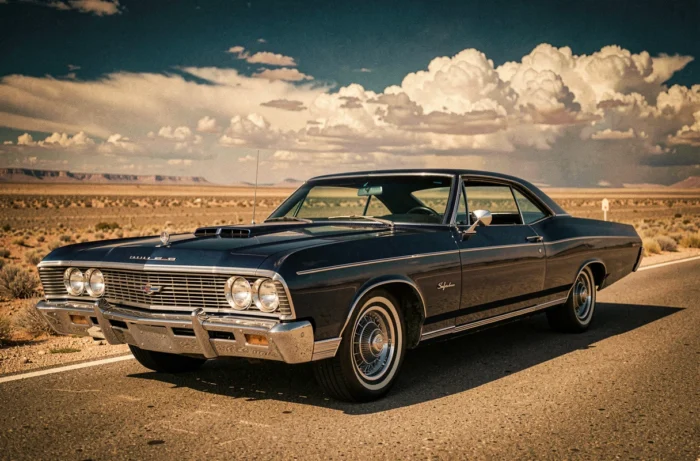
When searching for a Chevrolet Impala in the collector’s market, the first challenge is not finding a model. It’s distinguishing a reliable ad from fabricated content. In 2026, misinformation surrounding this legendary American car obscures both the actual state of the mechanics offered for sale and the truth.
Chevrolet Impala and fake ads: the trap of unofficial renders
Several fact-checking sites have reported a wave of viral content presenting 2026 Impala renders as if they were an official model. However, no relaunch of the Impala has been announced by Chevrolet or General Motors. No SS version, no launch schedule, no confirmed prototype.
These visuals circulate on social media and in automatically generated articles. They feature invented technical specifications, fanciful prices, and fabricated release dates. For anyone following the history of this automobile since its inception in 1958, this background noise complicates the search for reliable information.
This phenomenon is not trivial for enthusiasts exploring the automotive universe on Blog Automobile or other specialized sources: one must systematically trace back to the official source before believing in an Impala comeback.
Value of the collector Impala: a market more selective than it seems
The collector car market is going through a sorting phase. Analyses from September 2026 describe a generally softer context since 2024, with values stagnating on certain models that were once highly speculative.
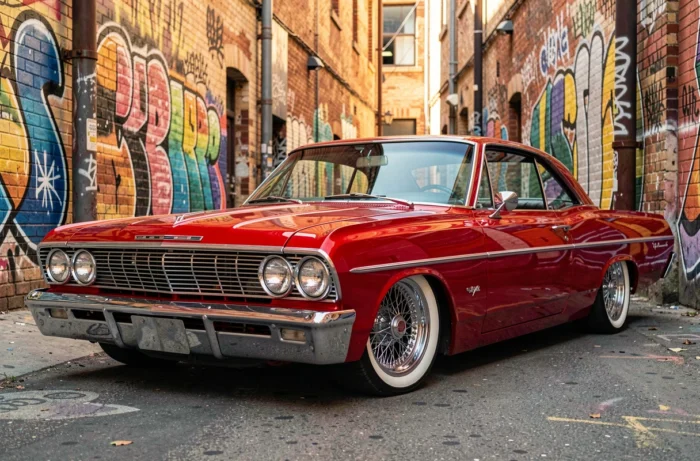
The Impala is not exempt from this trend. The 1965-1967 versions remain sought after, but the price gap between configurations is widening significantly. An original condition sports coupe with a period V8 engine does not fall within the same range as a partially restored four-door sedan.
Four-door Impala sedans: a discreet recovery
The four-door Impala variants, long undervalued compared to coupes and convertibles, are experiencing a measured and continuous increase. It’s more about a recovery of value than strong speculation. For a buyer who wants to drive rather than display, these models represent a more accessible entry point into the world of large American sedans.
Returns vary on this point depending on regions and mechanical condition, but the general trend remains stabilization rather than a surge.
Design and engine of the Impala: what creates tangible attachment
There is much talk about popular culture, the Supernatural series, and the American dream when mentioning the Impala. But on the ground, what attracts buyers relates to very concrete elements.
- The design of the 1958-1967 models combines long lines, pronounced rear fins, and a silhouette that resembles no European car of the same era. This visual identity remains immediately recognizable.
- The V8 engines of the first generation, inherited from the Corvette lineage, offered generous power for a vehicle aimed at the American middle class. The Impala was an accessible prestige model, designed to provide high-end performance at a controlled price.
- The mechanical robustness of these blocks still allows for regular maintenance today with parts available on the North American market, which is not the case for all classic cars from this period.
It is this combination of style, power, and maintainability that distinguishes the Impala in the muscle car and American collector car segment.
Buying an Impala in 2026: checkpoints before signing
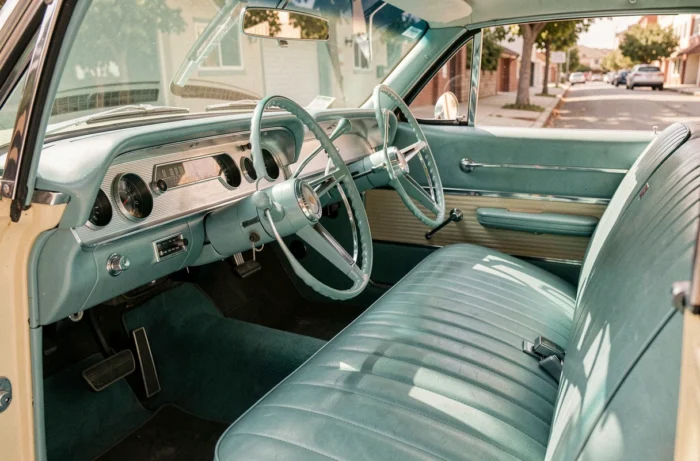
Finding an Impala is not enough. Verifying the authenticity of the announced configuration is the first step. On models from the 1960s, the code plate on the engine block and the chassis serial number confirm whether the original engine is still in place.
Restomod or original restoration
The choice between a restomod (period chassis with modernized mechanics) and a faithful restoration radically changes the budget and usage. A 1967 restomod with modern transmission and disc brakes will be more enjoyable to drive daily. An original restoration will have more heritage value but will require compromises on comfort and safety.
A well-documented restomod can resell properly, provided that the modifications are reversible and traceable. Serious buyers systematically request a complete restoration file.
Corrosion and body parts
On first-generation models, classic rust points are located at the wheel arches, rocker panels, and trunk floor. A visual inspection is not enough: the sheet metal must be probed in critical areas.
Reproduction body parts exist for most popular models, but their fit quality varies by manufacturer. Comparing several suppliers before ordering avoids unpleasant surprises during assembly.
Chevrolet Impala and automotive culture: a fascination that goes beyond the mere model
The Impala owes part of its fame to its presence in American popular culture, particularly in the Supernatural series where a black 1967 Impala accompanies the characters throughout the show. This media exposure has broadened the fan base well beyond the usual circle of collectors.
But the fascination also lies in what this car represents in American automotive history. Launched as a high-end variant of the Chevrolet Bel Air, the Impala became the best-selling model in the United States within a few years. This trajectory tells something about Chevrolet’s ability to position a vehicle between luxury and accessibility.
Today, the Impala remains a generational marker. It can be seen at lowrider gatherings in Los Angeles as well as at classic car shows. Its cultural versatility, from muscle car to urban cruiser, explains why it continues to attract very different buyer profiles, long after its production has ceased.