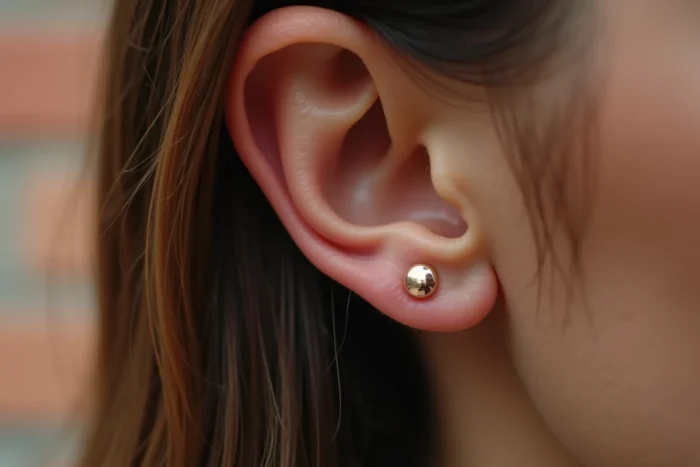
We want a flat piercing, we look at photos, we identify the flat area of cartilage above the ear canal, and we think it looks simple. Except that this specific area of the ear reacts differently than a lobe: the cartilage heals slowly, tolerates pressure poorly, and does not forgive material mistakes. Before making an appointment, a few technical points deserve our attention.
Anatomy of the flat cartilage and piercing constraints
The flat piercing goes through the flat, cartilaginous part of the outer ear, roughly between the helix and the rook area. Unlike the lobe (soft, well-vascularized tissue), this surface is covered by a thin nourishing membrane called perichondrium. It supplies nutrients to the cartilage and allows tissue repair.
When the needle pierces this area, the perichondrium is locally interrupted, which slows healing compared to a piercing in soft tissue. Cartilage does not regenerate like skin: it forms a fibrous tunnel around the jewelry, and this tunnel takes time to stabilize.
In practice, this means that prolonged pressure (sleeping on the pierced ear, wearing tight headphones) compresses the weakened cartilage and causes irritations, even keloids. It is generally recommended to use a pierced pillow or sleep on the other side throughout the healing period. For everything you need to know about flat ear piercings, these anatomical constraints are the starting point before any aesthetic considerations.
ASTM F-136 titanium: why the material of the first jewelry affects healing
Most guides talk about choosing a “good piece of jewelry” without specifying what that entails. The technical criterion to check is the certification of the metal. Implant-grade titanium ASTM F-136 is the universally safe choice for a first cartilage piercing, including flat piercings.
This grade of titanium is used in orthopedic surgery for joint implants. Its biocompatibility reduces allergic reactions and rejections, two common problems with low-quality alloys.
Materials to avoid for the first piercing
- Sterling silver (925): it oxidizes upon contact with healing secretions and can cause black spots on the skin, even chronic irritations
- Costume jewelry with plating: the plating wears off, exposing a base metal often rich in nickel, the primary contact allergen in Europe
- Surgical steel “316L”: despite its reassuring name, it contains nickel in varying amounts, and feedback on this point varies according to individual sensitivity
The additional cost of ASTM F-136 titanium compared to costume jewelry is justified by clearer healing and fewer follow-up visits to the piercer. You pay once, you heal once.
Healing duration for flat piercings: what 6 to 12 months mean in daily life
Piercing professionals agree on a healing range of 6 to 12 months for any cartilage piercing, including flat piercings. It’s a long time, and much content quickly overlooks the practical consequences of this duration.
During this period, the tunnel is not mature. The jewelry must not be removed, even briefly, or the hole may close within hours. You do not change jewelry before the end of complete healing, except in cases requiring the piercer’s intervention.
Concrete daily care
The care protocol is simpler than one might think, but it requires consistency. Clean with a sterile saline solution (physiological serum in vials or dedicated spray), morning and evening. No harsh disinfectants, no betadine, no alcohol.
Never twist the jewelry during healing. This old recommendation, still widespread, tears the cells forming in the tunnel and delays healing. Leave the jewelry alone, rinse, and dry with a non-woven compress.
Alert signs that justify a return to the piercer: redness extending beyond the piercing, pain increasing after the first week, discharge of green or yellow color, formation of a bump that does not decrease within two weeks.
Choosing a piercer for a flat piercing: concrete checks
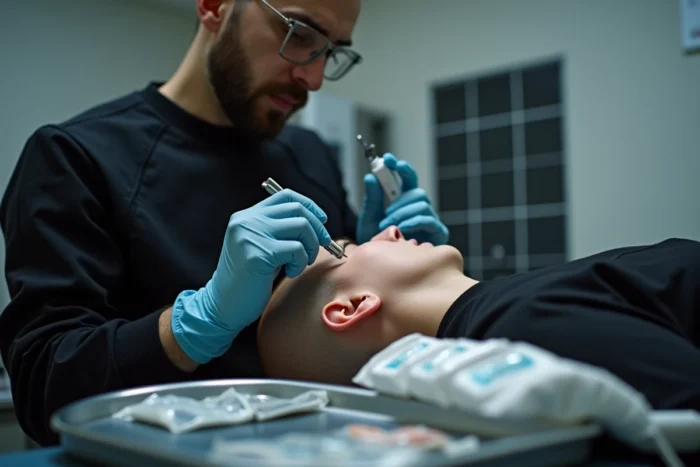
A competent piercer for flat piercings works with a needle, never with a gun. The gun cannot be sterilized in an autoclave and causes trauma by crushing the cartilage instead of making a clean cut. On cartilage, piercing with a gun increases the risk of cartilage fracture and keloid.
Beyond the tool, here are a few points to check before sitting in the chair:
- The studio uses single-use materials (needles, gloves, sterile fields) taken out of their packaging in front of you
- The autoclave is visible and its control log is accessible, in accordance with health traceability requirements
- The piercer offers an implant-grade titanium jewelry suitable for the thickness of your cartilage, not a standard size for everyone
- A follow-up appointment is scheduled a few weeks after the piercing to check healing and adjust the length of the bar if necessary
The initial length of the bar is intentionally longer to accommodate post-piercing swelling. Once the swelling subsides (usually after a few weeks), the piercer replaces the bar with a shorter one. A bar that is too long left in place catches, moves, and irritates the cartilage.
Flat piercing and age: why piercers advise against it before 16
Several professional sources converge on a practical recommendation: avoid cartilage piercings before around 16 years old. The reasoning is not purely regulatory. In younger individuals, cartilage healing is more capricious, and adhering to a care protocol over several months requires a discipline that not all teenagers possess.
The outer ear continues to develop during adolescence. A piercing done too early may migrate slightly as the cartilage grows, which alters the final aesthetic result.
The flat piercing remains one of the most discreet and graphic placements on an ear. Its success depends less on the design of the jewelry than on adhering to the technical chain: good material, good piercer, good care, and above all, the patience to wait for the cartilage to do its job.