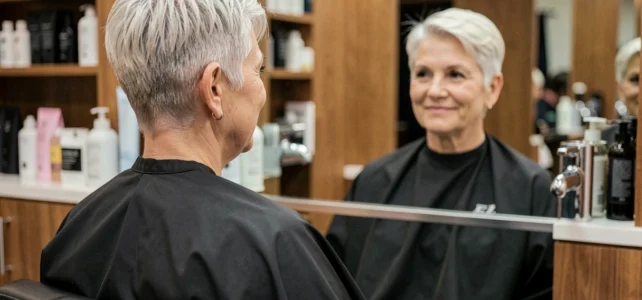
The long bob is often seen as a safe bet after 55 or 60 years old. It frames the face, masks a less defined jawline, and provides reassurance. Transitioning to a structured short cut means giving up this hair safety net, and the transition raises very concrete questions: compatibility with hair texture post-menopause, maintenance frequency, adaptation to glasses. Addressing these points in advance avoids most regrets.
Fine Hair After Menopause: Why Shorter Styles Compensate Better Than Longer Ones
With hormonal decline, hair loses density and diameter. A long bob on fine hair tends to lie flat against the scalp and highlights the lack of volume. The weight of the lengths pulls the roots down, accentuating the sparse effect on the top of the head.
A short cut, on the other hand, reduces the weight that flattens the roots and allows the hair to stand up naturally. The apparent volume increases without resorting to heavy texturizing products. It’s a simple mechanical principle: less length, less gravity, more hold.
Choosing a short haircut for senior women that suits your actual texture (and not the one you had at 40) radically changes the outcome. A stylist who works on dry, natural hair assesses the fall of fine hair better than one who cuts on wet hair, where everything looks thicker.

Short Haircuts for Senior Women and Glasses: An Adjustment Few Stylists Anticipate
After 60, most women wear glasses all the time. Frames alter the proportions of the face and interact directly with the haircut. This detail is rarely discussed in style advice, yet it changes the final look entirely.
Wide Frames and Exposed Temples
With rectangular or oversized frames, a short bob with sides that fall below the glasses’ arm creates a side overload effect. Exposing the temples above the arm lightens the frame of the face. The eyes remain the focal point, not the mass of hair stuck between the ear and the frame.
Thin Frames and Volume on Top
Discreet glasses allow for more freedom. A pixie with volume on top or a tapered short bob works without visual conflict. The goal remains to balance the upper third of the face (forehead, eyes, glasses) with the lower third (jawline, chin).
- Wide frames: favor short sides, an exposed nape, and volume concentrated on the top of the head.
- Round frames: a slightly asymmetrical short bob breaks the overall roundness of the face-glasses duo.
- Thin or rimless frames: almost all short cuts work, including a light shag or classic pixie cut.
Bringing a photo of your usual glasses to the hairdresser’s appointment may seem trivial, but it’s the most useful gesture to avoid a cut that “doesn’t look the same as in the salon.”
Budget and Maintenance Frequency for a Short Cut After 60
The long bob forgives regrowth. You can space salon visits three months apart without losing the shape of the cut. A structured short cut requires a touch-up every six to eight weeks to maintain its lines. This is a factor to consider before making the leap, not after.
In France, the indicative budget per visit ranges from 40 to 80 euros depending on the salon and region. Over a year, this represents a significant additional cost compared to a long bob maintained three to four times a year. For curly cuts styled on dry hair, the bill can increase even more.
This frequency is not a disadvantage for everyone. Some women appreciate the regularity of appointments as a care ritual. The key is to know this in advance, not to discover it when the cut starts to lose its shape after two months.
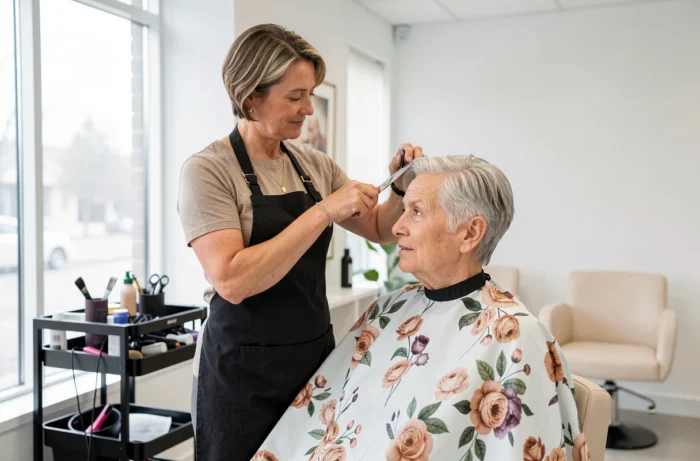
Gradual Transition from Long Bob to Short: Step-by-Step Method
Cutting 15 centimeters at once often causes a visual shock, even when the objective result is successful. The brain takes time to integrate a new face contour. Proceeding in steps mitigates this gap.
First Step: Chin-Length Bob
Transitioning from a long bob (shoulder-length) to a chin-length bob removes the heaviness of the ends without radically changing the silhouette. This step allows you to test daily manageability: does the hair hold without blow-drying? Is the natural volume sufficient?
Second Step: Ear-Length Bob
The short bob that stops at the earlobe is the real test. It exposes the nape, reveals the neck, and changes the relationship with clothing collars. If this length feels right after four to six weeks, moving to a pixie or textured short cut becomes an adjustment, not a leap into the unknown.
Spacing each step by a minimum of two months gives time to assess regrowth and styling ease. Cutting too quickly deprives you of this adaptation phase that makes the transition comfortable.
Color and Short Cut: What Changes When You Shorten
On a long bob, highlights and balayage create depth through the layering of colored lengths. On a short cut, this depth disappears: every centimeter of color becomes visible and exposed. A gray regrowth root is noticeable in two weeks on a pixie, where it went unnoticed for a month on a long bob.
Two realistic options arise. Either embrace the natural gray (and the short cut particularly highlights it, especially on dense white hair), or switch to a tone-on-tone color that gradually fades and avoids a harsh demarcation line. Permanent dyes with marked roots do not work well on short hair.
A well-executed short cut highlights the natural color of the hair. Silver gray, pure white, salt and pepper: these shades gain brilliance when not diluted over 30 centimeters of length.
The transition from a long bob to a short cut after 60 relies less on courage than on preparation. Hair texture, compatibility with glasses, actual maintenance budget, step-by-step transition, color management: addressing each parameter in advance reduces the risk of disappointment. The underlying trend towards feminine short cuts is not a seasonal fashion effect, and women who make the leap methodically rarely look back.