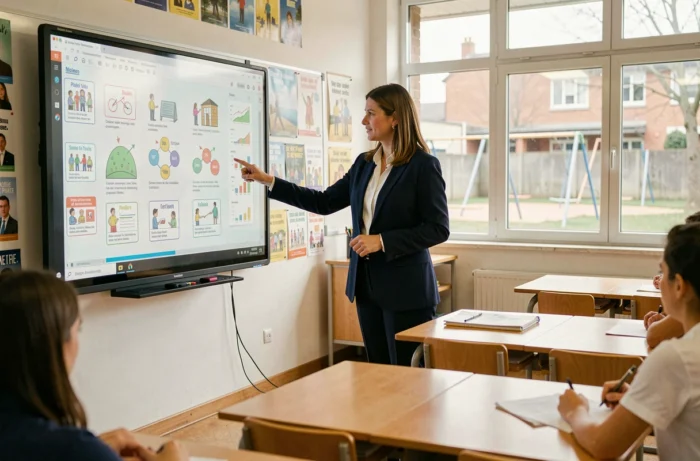
Since the start of the 2025 school year, French schools have been using artificial intelligence tools presented as sovereign. Conversational assistants for teachers, automatic transcription of meetings, translation of administrative documents: AI is no longer limited to a few isolated educational experiments. It is becoming part of the daily routine for educational teams, and this shift raises concrete questions about funding, control, and regulatory compliance.
Sovereign AI in Education: Who Pays and Who Controls Private Components
You may have noticed that the term “sovereign” often comes up when discussing public digital tools? In education, this means that the state deploys its own AI tools for staff. A conversational assistant helps synthesize documents. An automatic transcription module produces minutes of class councils.
These tools carry the sovereign label, but they are partly based on software components developed by private companies. Language models, computing servers, infrastructure layers: not everything comes from a public laboratory. The state assembles, configures, and hosts, but it purchases components on the market.
The question of control then becomes precise. Who audits the behavior of the language model used by the conversational assistant? Who verifies that the data of students or teachers is not exploited beyond the intended scope? Monitoring avenues exist, notably on https://edunews.fr/ where news about digital education is tracked alongside institutional announcements.
For now, the audit framework remains unclear between private providers and public administration. Public contracts define specifications, but the continuous technical verification of an AI model is not the same as controlling a traditional management software. A model can drift in its responses without the source code changing.
European Regulation on AI and Education: What Changes in August 2026
The European framework on artificial intelligence classifies certain educational systems as “high risk.” Specifically, AI tools used for assessment, guidance, or selection of students will be subject to enhanced obligations starting August 2, 2026.
This affects very concrete uses. An algorithm that proposes guidance at the end of middle school falls into this category. An automated system that grades papers or sorts Parcoursup files does too.
Concrete Obligations for Institutions and Publishers
The requirements focus on several axes:
- Transparency: families and students must be informed that an AI system is involved in a decision that concerns them, and understand on what criteria it operates.
- Human supervision: a teacher or educational staff must be able to intervene, correct, or invalidate the decision made by the automated system.
- Technical documentation: the software publisher must provide documentation describing the training data, known limitations of the model, and compliance tests conducted.
For institutions, this means that an AI tool can no longer be adopted solely based on a commercial demonstration. Each deployment of high-risk AI will require documented compliance evaluation.
AI as an Administrative Lever for Teachers in France
The most concrete feedback from the field does not focus on classroom pedagogy. It focuses on paperwork. Synthesis of institutional documents, writing reports, meeting minutes: these are the administrative tasks that AI is transforming first and foremost for teachers.
Why this discrepancy with the usual image of school AI? Because pedagogical use in the classroom requires training time, adaptation to curricula, and scientific validation. Administrative use, on the other hand, can start without modifying classroom practice.
Measured time savings focus on document synthesis and repetitive writing. A pedagogical council report that took an hour to write can be produced in a few minutes from an automatic transcription, then reviewed and corrected by the teacher.
Limits of This Productivity-Driven Approach
This type of deployment does not address the fundamental question: how can AI improve student learning? Administrative uses are useful, but they do not impact the classroom. However, the majority of teachers surveyed in recent studies believe that the integration of AI could personalize learning and better meet the specific needs of each student.
The transition from administrative AI to pedagogical AI requires an investment in teacher training. Not theoretical training on “what a large language model is,” but practical support: how to use it in a lesson sequence, how to verify the reliability of a generated response, how to explain to students what an algorithmic bias is.

Material Resilience of Schools: Heatwaves, Renovation, and Digital
The educational news in 2026 is not limited to digital. Debates are also focused on the physical adaptation of institutions. The layout of schools in response to heatwave episodes, the thermal renovation of school buildings, and tensions around the use of social networks by minors are increasingly prominent.
This link between innovation and infrastructure deserves to be highlighted. Deploying digital tools in overheated classrooms where the Wi-Fi network is unstable does not produce the expected results. Educational innovation depends as much on the condition of buildings as on the quality of software.
The renovation projects initiated for the 2026 school year gradually incorporate this dual dimension: thermal comfort and connectivity. Local authorities, which fund school buildings, are arbitrating between competing priorities with constrained budgets.
The question of students’ digital well-being adds a layer of complexity. Regulating the use of screens and social networks while training in AI requires a coherence that many institutions are still building on a case-by-case basis, without a stabilized national doctrine.