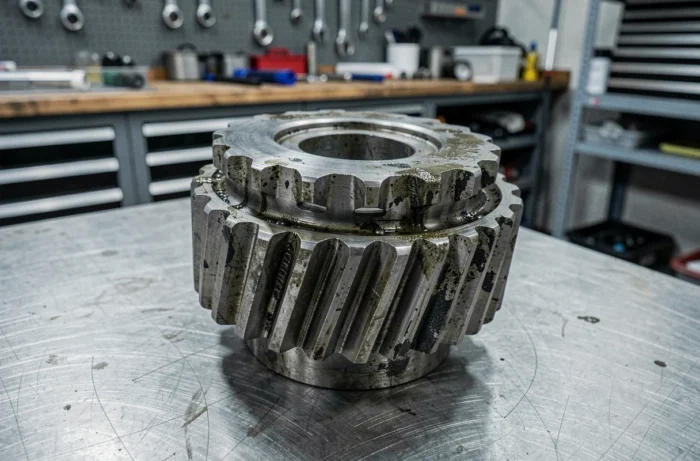
Dog-clutch transmissions are now fitted to a growing number of hybrid vehicles sold in Europe, driven by Renault’s E-Tech range. This transmission technology, historically reserved for motorsport, is based on an old mechanical principle: straight-cut gears that mesh without friction. Its return to mass-produced cars raises specific technical questions about how it performs in everyday driving, how durable it is, and what compromises it requires drivers to accept.
How dog clutches work compared with synchronizers
In a conventional gearbox, synchronizers match the rotational speeds of the gears before a gear is engaged. This process feels smooth to the driver, but creates friction losses and adds weight to the transmission.
A dog-clutch gearbox eliminates synchronizers. The gears remain in constant mesh on the shafts, and gear changes happen when interlocking teeth (the dog clutches) directly lock a gear in place. Renault claims 98.5% efficiency per gear mesh, a figure that explains why this design is appealing for improving the efficiency of a hybrid powertrain.
Without synchronizers, the gearbox is more compact and lighter than a traditional manual transmission. Fewer moving parts also mean fewer potential sources of mechanical wear, at least in theory. A guide explaining the advantages and disadvantages of a dog-clutch gearbox provides a closer look at the extent of these structural differences.
The downside of this mechanical simplicity is that gear changes can potentially be abrupt. Without the smooth action of a synchronizer, engagement depends entirely on electronic control to synchronize engine speeds via the electric motors. Any software imprecision results in a noticeable jolt.
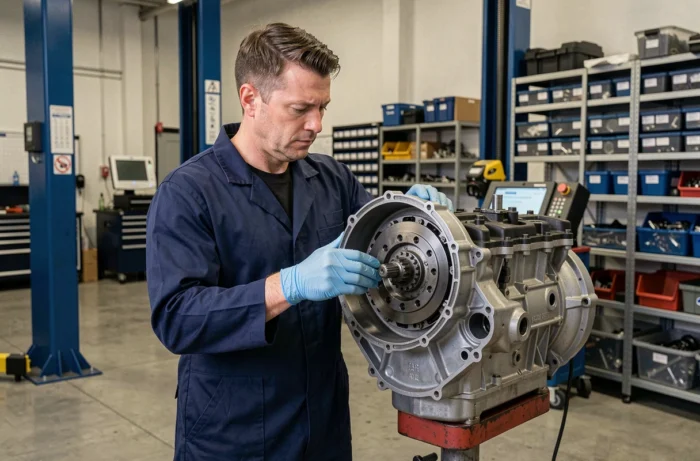
Dog-clutch gearbox and Renault E-Tech hybrid system: a multi-mode design
Renault’s choice is not simply a matter of replacing a conventional automatic gearbox. The E-Tech system’s dog-clutch gearbox manages several operating modes during a single journey: pure electric, series hybrid, parallel hybrid, or engine-only. The main electric motor handles starting and reversing, eliminating the torque converter and launch clutch.
This multi-mode design relies on a distinctive layout. Two electric motors and an internal combustion engine work together through the gearbox, allowing the system to continually select the most efficient configuration. In the Renault Duster hybrid tested by Autocar India, the transmission can switch between all four modes without any input from the driver.
How it feels behind the wheel
The driving experience differs from that of the e-CVT transmissions found in Toyota and Honda models. The typical “rubber-band” effect of a CVT, where the engine revs rise without a corresponding increase in acceleration, is absent. The dog-clutch gearbox’s distinct gear ratios feel more mechanical and conventional.
Autocar India does, however, note a slight hesitation when pulling away and a temporary drop in power during some gear changes. This compromise is inherent to the dog-clutch principle: even when software reduces engagement time to a few dozen milliseconds, it creates a brief interruption in torque that friction-based transmissions naturally mask.
Dog-clutch gearbox reliability: real-world reports and known limitations
Long-term reliability remains an open question. Reports published on platforms such as Motorfiable and Renault forums include accounts of irregular gear changes in some E-Tech models. Reported symptoms include:
- Pronounced jolts when switching between electric and engine power, particularly at low speeds in urban traffic
- Unusual noises (clunks, rumbling) under load, reported especially when driving uphill
- Gear changes that feel hesitant after restarting the vehicle when the engine is warm
One key piece of information is missing when assessing the severity of these symptoms: the available sources do not document any manufacturer recall specifically targeting a structural defect in the E-Tech dog-clutch gearbox. Renault has issued software updates, suggesting that electronic calibration, rather than the mechanical components themselves, is the main focus of corrective measures.
The distinction between a hardware defect and software that could be better calibrated changes how reliability should be viewed. If the gearbox’s mechanical components are sound but its software produces jolts, an update may resolve the issue without replacing any parts. Individual accounts, however numerous, cannot establish a failure rate unless they are backed by an independent study or an official recall.
Dog-clutch gearboxes in motorsport and production cars: two different sets of demands
Dog-clutch gearboxes have dominated Formula 1 and rallying for decades. The reason is straightforward: changing gear without interrupting power delivery saves tenths of a second with every shift. In this context, jolts are not considered a flaw; they are accepted as the price of speed.
In a production car, the priorities are reversed. Drivers expect gear changes to be as comfortable as those in a conventional automatic. The control software must therefore smooth out engagement, which slightly slows the transition and can cause the brief hesitations described above.
This tension between outright performance and everyday comfort explains why dog-clutch gearboxes have not replaced dual-clutch transmissions or CVTs across the market. Their appeal remains tied to hybrid designs in which electric motors compensate for brief interruptions in torque—a role that an internal combustion engine alone cannot fulfill.
In modern cars, the dog-clutch gearbox is neither a universal solution nor a niche curiosity. Its mechanical efficiency makes it a good fit for hybrids seeking to increase the proportion of energy delivered to the wheels. Its limitations depend on the quality of the software controlling it, a factor manufacturers continue to refine with each update.