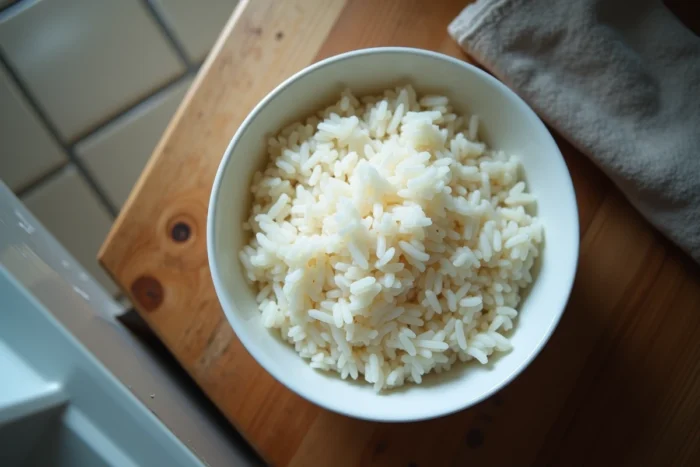
A leftover rice forgotten on the countertop for a few hours after a meal, then reheated in the evening in the microwave: this is the typical scenario of the fried rice syndrome. This food poisoning, caused by the bacterium Bacillus cereus, does not forgive conservation errors. And contrary to what its name suggests, it does not only concern rice.
Bacillus cereus and emetic toxin: why reheating is not enough
It is often thought that a trip to the microwave or frying pan eliminates all risk. In reality, this is false. The real danger comes from the toxin already present in the food, not from the active bacteria at the time of consumption.
Bacillus cereus produces spores that are extremely heat-resistant. Once cooking is complete, if the food remains at room temperature, these spores germinate and the bacteria multiply. It then releases an emetic toxin (responsible for vomiting) that also withstands heat. Reheating the dish may kill any live bacteria, but the toxin remains intact and active.
This is why one can fall ill from eating a dish that has been reheated at high temperature. To find information on L’Art du Goût, the mechanism of this contamination is detailed precisely.
Bacillus cereus also produces a second type of toxin, which causes diarrhea and is released directly into the intestine after ingestion. The two clinical presentations (emetic and diarrheal) correspond to different toxins, but the common point remains the same: a cooked food left too long outside the refrigerator.
Fried rice syndrome: foods affected well beyond rice

The name “fried rice syndrome” is misleading. It comes from documented cases after consuming reheated rice, but all starchy foods are exposed to the same risk. Pasta, potatoes, noodles, cooked vegetables, and even sauced meat dishes can harbor Bacillus cereus under the same conditions.
The widely reported case of a young Belgian who died after consuming a pasta dish stored for several days at room temperature, as reported in the Journal of Clinical Microbiology, illustrates this reality. It was not rice, but the contamination mechanism was identical.
We tend to monitor the cold chain for meat or fish but neglect starchy foods. A bowl of pasta left on the buffet table during a party, a mashed potato forgotten in the pot after dinner: these commonplace situations create a favorable environment for the multiplication of Bacillus cereus and the production of its toxins.
Symptoms of Bacillus cereus poisoning: two distinct forms
The symptoms of fried rice syndrome appear quickly after ingestion. Two clinical forms exist, depending on the toxin involved:
- Emetic form: nausea and vomiting that occur in the first few hours after the meal. This is the form most often associated with poorly stored rice or pasta.
- Diarrheal form: abdominal cramps and diarrhea, with a slightly longer onset time. This form is related to the toxin produced in the intestine after ingestion of the bacteria.
- In the vast majority of cases, the progression is mild and symptoms disappear within a few hours. Serious complications are rare but possible, especially in vulnerable individuals or in cases of massive exposure to the toxin.
The trap is that the symptoms resemble those of classic gastroenteritis. One does not necessarily think of food poisoning related to leftover starchy foods.

Storage of cooked starchy foods: concrete actions to prevent poisoning
Prevention is based on a simple principle: never leave cooked starchy food at room temperature for more than two hours. In practice, the following rules should be applied:
- Refrigerate rice, pasta, or potatoes within an hour after cooking, spreading them out in shallow containers to speed up cooling.
- Do not store leftover starchy foods in the refrigerator for more than one day. Beyond that, the risk of bacterial multiplication increases even in the cold.
- Never reheat a dish that has already been reheated once. Each cooking-cooling cycle offers an additional window for Bacillus cereus.
- Avoid preparing large quantities in advance without a quick cooling plan. Large volumes take longer to cool down, prolonging the danger zone.
Opinions vary on the exact duration of storage in the refrigerator according to sources, but the operational consensus is around twenty-four hours maximum for cooked starchy foods. Beyond that, it is better to throw it away.
Reheated rice and misconceptions: what really changes the game
It is sometimes said that rinsing rice before cooking eliminates the risk. Rinsing reduces the amount of surface starch, but it does not destroy the spores of Bacillus cereus, which are already present on the raw grain. Cooking does not eliminate them either, as these spores can withstand high temperatures.
The only effective lever remains the management of time between cooking and cooling. The entire prevention chain relies on this window. Cooked rice, quickly cooled and consumed within the day poses no problem. The same rice left out for four or five hours on the countertop becomes a real risk.
This logic also applies to prepared dishes purchased commercially. A container of fried rice taken out of the refrigerator and left in a shopping bag during a hot afternoon can become problematic, even if the expiration date has not been exceeded.
Fried rice syndrome is neither rare nor exotic. It is a common food poisoning related to storage habits that most of us apply poorly. Cool quickly, store cold, consume quickly: three reflexes that are enough to eliminate almost all risk.