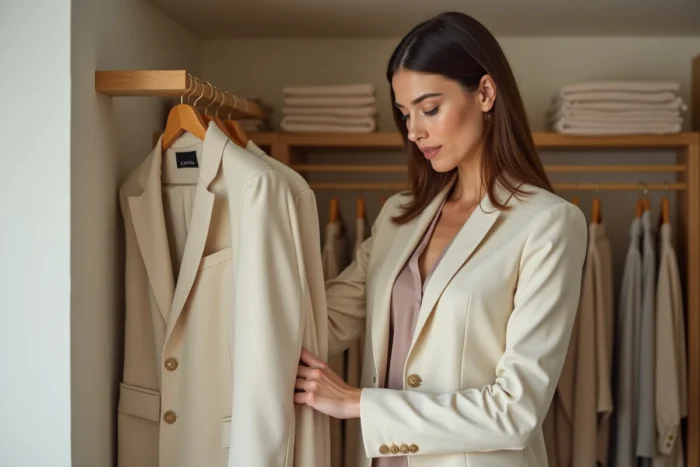
A garment inspired by a major fashion house carries neither a logo nor a monogram, but incorporates specific codes: cut proportions, placement of details, choice of finishes. Distinguishing this category from a counterfeit or a simple basic requires reading the garment like a technician, not like a consumer.
Cut Proportions and Placement of Technical Details
Fashion houses work on specific proportion ratios for each silhouette. A blazer with a shoulder that falls exactly at the edge of the acromion, a narrow collar gorge, and a closure button placed at the natural waist signals Parisian tailoring inspiration. Low-end copies never accurately reproduce these placements.
We observe that mid-range brands inspired by major ateliers often retain a recognizable structural element: the armhole height of a Balenciaga, the dropped shoulder line of a Lemaire, the characteristic sleeve volume of a Dior pattern. The rest of the garment may differ, but this construction detail betrays the source.
To follow fashion news on Magmoiselle, this reading of proportions helps identify pieces that deserve attention among mid-range collections.
Three areas to systematically examine:
- The shoulder line and armhole height, which define the overall silhouette and vary greatly from one house to another
- The placement of the closure point (button, hook, zip) relative to the natural waist, a marker of a well-crafted pattern
- The depth and shape of the collar or lapel, which reveal whether the pattern follows a tailoring tradition or a simplified industrial cut
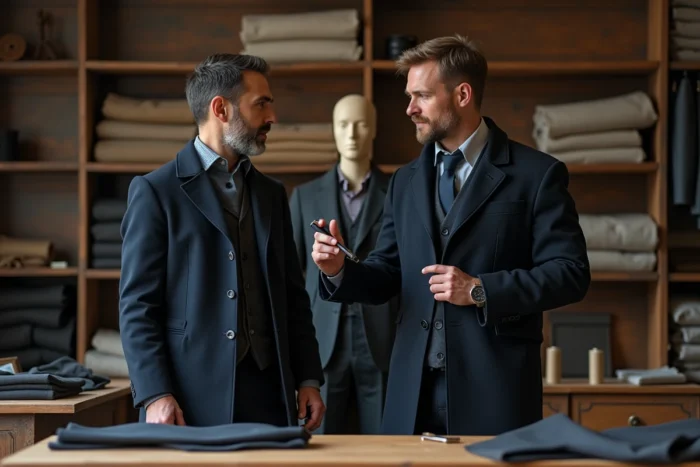
Textile Finishes and Seams: Reading a Garment Without a Label
A fabric that gives a high-end appearance is not recognized solely by touch. The density of the weave, visible in backlight, remains the first reliable indicator. A tight and even weave absorbs light instead of letting it pass through.
Brands inspired by major houses use end-of-stock materials or Italian suppliers that produce for luxury. This gives them access to fabrics with significantly higher weight and hand feel than fast fashion textiles.
The inner seams tell as much as the fabric. A clean overlock with a regular stitch, generous seam allowances (not trimmed to a minimum), hand-rolled hems or at least imitated by an invisible machine stitch: these details signal a manufacturing process that mimics couture standards.
Seam Allowance and Partial Lining
Haute couture ateliers systematically line their structured pieces. A jacket inspired by this level will present at least a body lining, even if the sleeves remain unlined to reduce costs. The complete absence of lining on a structured piece excludes any serious couture inspiration.
The seam allowance (the margin left after assembly) often exceeds one centimeter on high-end inspired pieces. On a fast fashion garment, this margin is reduced to the strict minimum to save fabric. Turning the garment inside out and measuring this allowance provides immediate information.
Discreet Branding and Absence of Authentication Device
Since 2024, online authentication services have structured their methods around systematic photography of key areas: logo, seams, labels, hardware, serial numbers. This professionalization has highlighted a growing category of “no logo” or discreet branding pieces.
These garments faithfully reproduce the cuts, proportions, and placements of typical details from certain houses, but without using their trademarks. We recommend checking one simple point: an inspired piece clearly displays its own brand on the label, without attempting to imitate the typography or packaging of the original designer.
Differentiating Legal Inspiration and Counterfeiting
The line between inspiration and copying rests on intellectual property. A registered textile pattern (the Vuitton monogram, the Burberry tartan in its registered version, the Dior Oblique) cannot be reproduced. However, a cut, volume, or proportion ratio does not benefit from the same legal protection.
Mid-range brands that operate legally therefore incorporate non-protectable style elements:
- The overall silhouette and volumes (oversized shoulders, defined waist, midi length)
- Visible construction techniques (pleats, princess seams, raglan armholes)
- The choice of similar materials without reproducing registered patterns
- Color palettes close to recent collections without copying exclusive colors
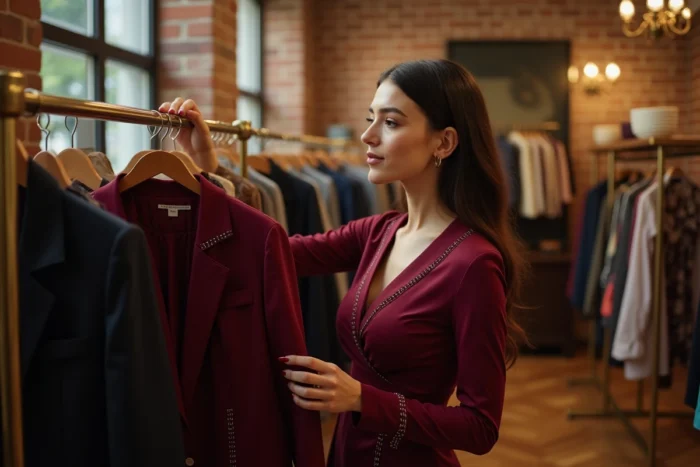
Seasonal Codes and Timing of Fast Fashion Collections
Zara, H&M, and other fast fashion players launch their interpretations a few weeks after the shows. This time lag is an indicator in itself. A piece that appears in stores within two months following a Fashion Week and that adopts a striking silhouette from the show is, by definition, a quick adaptation.
Brands with more refined inspiration take more time. They rework the pattern, select a higher quality fabric, and adjust the finishes. The time between the show and the sale provides insight into the level of elaboration of the piece.
A carefully inspired garment does not seek to reproduce a complete runway look. It isolates a design element (a sleeve, a collar, a shoulder construction) and integrates it into a clean pattern. This selective approach distinguishes the stylist’s inspiration from the industrial copying of fast fashion, which reproduces the entire silhouette while simplifying each construction detail.
Identifying these pieces requires watching the shows in advance, then looking not for the overall resemblance, but for the reproduction of a single technical detail executed with care. This is where the real value of a garment inspired by major houses lies.