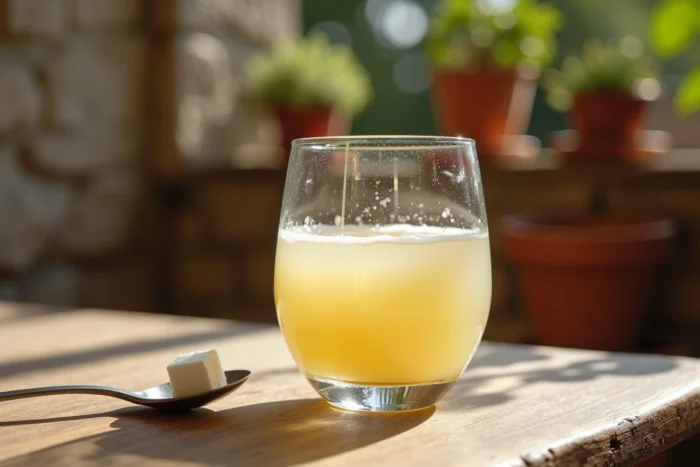
Two centimeters of pastis are poured into the bottom of the glass, five to seven volumes of fresh water are added, and the result seems harmless. The golden color, the smell of anise, and the abundant dilution give the impression of a light drink. However, behind this appearance lies a double burden for the body: alcohol and sugar, whose combined effects are rarely detailed on labels.
What pure pastis really contains in carbohydrates and sugars
When looking at the nutritional information for pure pastis (undiluted), we find about 2.8 g of carbohydrates per 100 g of liquid, including 2.3 g of sugars. Compared to the average of liqueurs and spirits (5.6 g of carbohydrates per 100 g), pure pastis is below the average for spirits in terms of carbohydrates.
The trap is that we do not drink pure pastis. We dilute it, which increases the volume consumed and can make it easier to refill. An aperitif that stretches over an hour with two or three glasses completely changes the balance. By trying to find out how much sugar is in a glass of pastis, we realize that the sugar added to the spirit itself is only part of the problem: it’s the accompaniments (syrup, soda, grenadine) that tip the scale.
Common brands (Ricard, Pernod, Pastis 51) correspond to this nutritional profile. None contain proteins or fats. Almost all of the caloric intake comes from the alcohol itself, not from residual sugar.

Alcohol and sugar in the same glass: the mechanism of the double metabolic burden
We often separate the issue of sugar from that of alcohol. Recent prevention documents, particularly those from Santé publique France, remind us that the combination of alcohol and free sugars increases the risk of overweight, type 2 diabetes, and cardiovascular diseases. It’s not one or the other: it’s their association in the same drink that poses a problem.
The classic aperitif scenario illustrates this mechanism well. One takes a pastis diluted with orgeat syrup or mint, accompanied by chips or peanuts. The liquid sugar causes a rapid release of insulin. Alcohol, prioritized by the liver, prevents normal regulation of blood sugar levels. The result: a drop in blood sugar that translates into fatigue and a desire to snack or refill.
The craving-sugar cycle during the aperitif
This phenomenon is documented in the medical literature: a sugary liquid load causes a spike in insulin followed by a rapid drop in blood sugar, promoting repeated consumption of sweetened or alcoholic drinks in the same sitting. We all know that moment when the second pastis “goes down easily” after the first.
This is not a question of willpower. It’s a physiological mechanism. Alcohol disinhibits, sugar calls for sugar, and the liver cannot manage both fronts simultaneously.
“Light” pastis and zero sodas: a false good idea for health
In light of these findings, one might think that replacing sugar with sweeteners (in a zero soda used as a diluent, for example) solves the problem. Recent studies on sweeteners show that it’s not that simple.
- Sugar substitutes can disrupt the gut microbiota and alter metabolic response, according to research reported by specialized biology publications.
- The sweet sensation without real calories can maintain the sweet consumption reflex and does not necessarily reduce appetite for the rest of the meal.
- Alcohol remains present in the glass, with its own calories and hepatic effects, whether the diluent is sweetened or not.
In other words, a pastis diluted with zero soda still contains as much alcohol as a classic pastis. You save a few grams of sugar, but do not change the core of the problem.
Calories in pastis compared to other aperitif spirits
Pure pastis has about 274 calories per 100 g, placing it in the higher range of spirits. But the raw comparison is misleading because we do not drink 100 g of pure pastis at once. The standard dose of a glass of pastis (about 2 to 3 cl of spirit, topped with water) brings the caloric intake per glass to a level comparable to that of a glass of wine or a standard beer.
What makes the difference in real situations:
- Plain pastis (still water, without syrup) remains relatively low in calories per served glass.
- The addition of syrup, grenadine, or sweet soda can double the caloric intake of the glass without us realizing it.
- The duration of the aperitif plays a major role: two pastis-syrup over an hour provide as much sugar as a dessert.
The real risk factor is not pastis itself, but the context in which it is consumed: quantity, sweet accompaniments, duration of the session, weekly frequency.
Reducing the impact without giving up the aperitif ritual
We do not need to eliminate pastis to limit metabolic damage. A few concrete adjustments can change the balance of an aperitif.
The first lever is the diluent. Still water or plain sparkling water, without syrup or soda, eliminates the added sugar load. The anise flavor is strong enough to do without additional sugar.
The second lever is the amount of spirit. Reducing the amount of pure pastis in the glass proportionally decreases alcohol and calories. You can increase the water without losing the taste.
The third point concerns the pace. Alternating a glass of pastis with a glass of still water slows down the insulin cycle described above. Feedback on this point varies, but simply spacing out the glasses mechanically reduces the load on the liver.
Santé publique France reminds us that no level of alcohol consumption is considered “risk-free.” Pastis is no exception, despite its moderate sugar content compared to other spirits. It’s the repeated combination of alcohol-sugar-extended aperitif that constitutes the real metabolic risk area, much more than the content of an isolated glass.