Renovating an interior in 2026 is no longer just about choosing a wall color or changing a countertop. The regulatory framework has shifted significantly in recent months, and financial aid has refocused on very specific areas. Before thinking about decoration or layout, home renovation today requires understanding what has changed, what remains eligible for funding, and what is purely an aesthetic choice to be made independently.
Energy Audit and DPE: What Regulations Require Before Renovating
Since January 1, 2025, selling a house classified E, F, or G according to the DPE requires a regulatory energy audit in addition to the energy performance diagnosis. This document, provided at the first visit and attached to the sales promise, outlines work pathways towards efficient renovation, either in one step or through successive stages.
This obligation does not apply to condominiums, but it changes the game for owners of single-family homes. Specifically, a property classified E or F that comes onto the market must display a detailed renovation plan. The buyer knows exactly what work is recommended.
For homeowners renovating without the intention to sell, the audit is not mandatory. However, conducting it helps prioritize interventions and avoid spending on areas that do not actually improve the performance of the housing. A qualified professional, who can be found at pp-renov-motiv.be, assists with this diagnostic step.
MaPrimeRénov’ Since September 2026: Which Works Remain Fundable
Decree No. 2026-822 has profoundly changed the landscape of renovation aid. Since September 1, 2026, the MaPrimeRénov’ pathway now primarily funds heat pumps (air/water, geothermal, solar thermal), connection to a heating or cooling network, the removal of oil tanks, and energy audits.
Most insulation work taken individually (walls, roofs, windows), ventilation, and many biomass or wood equipment are no longer eligible outside of a comprehensive renovation. This refocusing on decarbonized heating strongly influences household choices.
Direct Consequence on an Interior Renovation Project
If your project includes replacing an oil or gas boiler with a heat pump, the aid remains accessible and significant. However, insulating walls alone or changing windows no longer triggers a grant outside of a comprehensive renovation pathway. Therefore, one must decide between:
- Launching a coordinated comprehensive renovation (insulation, heating, ventilation) to access the supported pathway aids, with a mandatory Rénov’ facilitator
- Self-funding insulation or carpentry work if the budget allows, accepting the absence of subsidies
- Postponing certain aesthetic elements (finishes, kitchen layout) to focus the budget on eligible work
Field feedback varies on the effectiveness of this reform to accelerate the renovation of the existing stock. Some professionals observe a wait-and-see attitude among households due to the complexity of the pathways.
Biosourced Materials and Reuse: A Structuring Sector
Beyond thermal performance, the sustainability of a renovation depends on the choice of materials. Biosourced materials (hemp, flax, cellulose wadding, wood) are gaining ground in interior renovation projects, driven by environmental goals and a diversifying supply.
The reuse of construction materials, long marginal, is beginning to take shape. This approach also works on ambitious projects, provided there is a sufficiently developed local supply chain.
What This Changes for a Modern Interior
Choosing a biosourced insulation for interior walls alters the thickness of the partitions and thus the usable space. A hemp-flax insulation with good thermal performance is thicker than a synthetic insulation with equivalent resistance. This compromise should be addressed early in the design phase, especially in homes where every square meter counts.
Reuse mainly concerns secondary elements: doors, flooring, sanitary fixtures, lighting. Integrating reused pieces into a contemporary interior requires selection and refurbishment work, but the result brings a uniqueness that standardized new materials do not replicate.
Aesthetic Renovation Without Aid: Areas to Decide for Yourself
Once the energy aspect is addressed (or set aside due to budget constraints), the question of visual modernization remains. Online competitors offer lists of decorative gestures, from painting to replacing light fixtures. These interventions are real, but they fall entirely within a private budget.
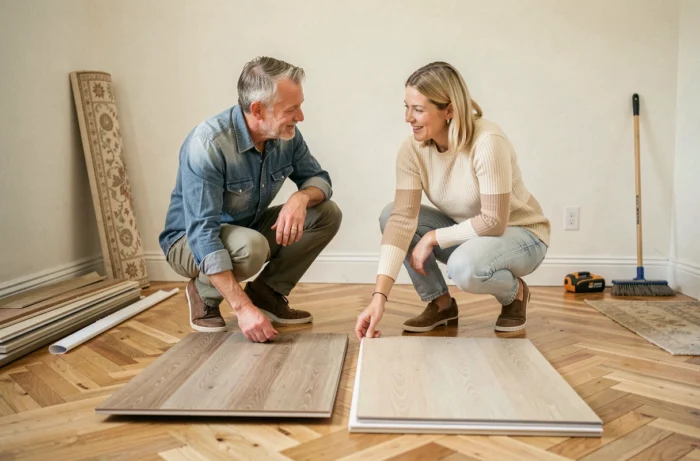
The choice of flooring deserves particular attention. A large-format ceramic tile or a laminate floor radically transforms the atmosphere of a living space. The flooring is the aesthetic element with the best visual impact/cost ratio in an interior renovation.
Lighting comes right after. Replacing dated ceiling fixtures with a system combining indirect sources and targeted light points changes the perception of volumes without touching the structural work. LED fixtures with adjustable color temperature allow for adapting the ambiance according to usage.
- Floor: prioritize a durable and easy-to-maintain material, compatible with underfloor heating if a heat pump is planned
- Walls: paint remains the most accessible lever, but a lime plaster or wood cladding adds a texture that paint alone cannot produce
- Interior carpentry: replacing hollow-core doors with solid-core models improves both acoustics and the overall appearance of the housing
The temptation to renovate everything at once often clashes with budget realities. Prioritizing areas based on their real impact on daily comfort helps avoid spreading resources too thin. A new floor and rethought lighting in the main living area produce a more noticeable change than a superficial renovation spread across all rooms.
Renovating an interior in 2026 involves two distinct aspects: a regulatory and energy component, framed by obligations and refocused aids, and an aesthetic component, entirely the owner’s responsibility. Confusing the two leads to disappointments, either by discovering that an area is no longer subsidized or by neglecting work that will condition the property’s value upon resale.