
The vacuum preservation tables found online display durations calculated under laboratory conditions: stable temperature, perfect sealing, maximum vacuum level. In a domestic refrigerator, these conditions are rarely met.
The temperature fluctuates with each door opening, some areas are warmer than others, and external vacuum machines do not reach the same vacuum level as a professional bell jar device. Understanding this gap between theory and practice allows for vacuum food preservation without taking risks.
Actual Refrigerator Temperature and Vacuum Preservation
The vacuum preservation durations published by manufacturers assume a continuous maintenance between 0 and 3 °C. Professional protocols indicate that the durations of 7 days for meats or prepared dishes are only reliable below 3-4 °C continuously. In practice, a home refrigerator often exceeds this range.
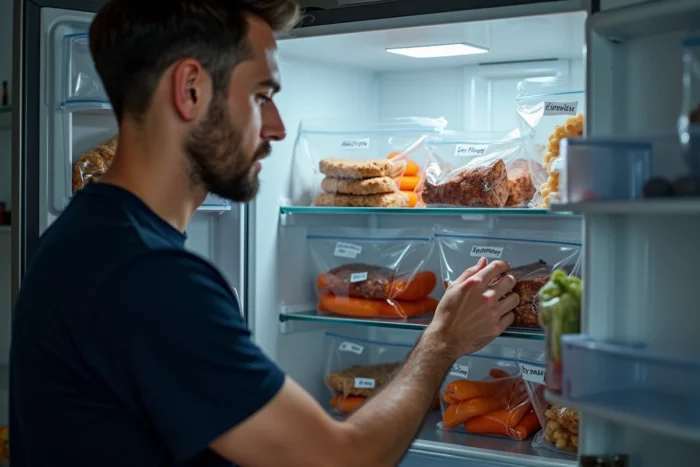
A standard domestic fridge typically oscillates between 4 and 7 °C depending on the area and the frequency of door openings. The upper part is generally warmer than the bottom, and the door remains the least cold area. Storing a vacuum-sealed bag of raw meat in the vegetable drawer or on the top shelf effectively shortens its actual lifespan by several days compared to the advertised figures.
To approach theoretical conditions, a thermometer placed in the center of the refrigerator allows for checking the effective temperature. If it regularly exceeds 4 °C, a safety margin should be applied to the vacuum food preservation duration indicated in reference tables. Reducing the stated duration by one third is a reasonable precaution when the temperature of the device is not precisely controlled.
Vacuum Level and Sealing Quality: What Changes the Game at Home
The applied vacuum level directly influences the preservation duration. A professional bell jar device reaches 99% vacuum, which corresponds to the maximum durations in the tables. External vacuum machines, more common among individuals, reach a lower level, often around 80 to 90%.
This difference is not trivial. A partial vacuum leaves more residual oxygen in the bag, which accelerates oxidation and bacterial growth. For delicate products like raw fish or tomatoes, the vacuum level is intentionally reduced (to avoid crushing the food), which further decreases the effective preservation duration.
The Sealing: An Underestimated Weak Point
An imperfect seal negates the benefits of vacuum sealing. Folds in the bag, liquid or grease residues on the sealing area, or a bag that is too thin are all causes of micro-leaks invisible to the naked eye. A defective seal drops the preservation well below theoretical values. Visually checking for the absence of air bubbles after vacuum sealing and testing the bag’s integrity by gently pressing on it are two reflexes to adopt systematically.
Vacuum-Sealed Foods in the Refrigerator: Where to Apply a Safety Margin
Not all foods react the same way to a temperature deviation or incomplete vacuum. Certain categories deserve increased vigilance.
- Raw meats (beef, pork, poultry) and raw fish are the most sensitive. A 2 °C deviation above the target temperature can halve their actual vacuum preservation duration. It is better to consume them in the first few days rather than relying on maximum durations.
- Prepared dishes cooled before vacuum sealing preserve better, provided that the cooling was rapid. A dish that remained warm for more than an hour before packaging will have already initiated bacterial growth that vacuum sealing cannot reverse.
- Raw vegetables (carrots, zucchini, peppers) tolerate temperature fluctuations better. Their vacuum duration in the refrigerator remains reliable even with a fridge set at 5 °C, as long as the sealing is correct.
- Hard cheeses handle vacuum sealing and moderate thermal variations well. In contrast, soft cheeses continue to mature under the bag, altering their texture and taste.
Rapid cooling before vacuum sealing is a step that consumer guides rarely mention. Professional protocols require a pass through a cooling cell. At home, placing the dish in a cold water bath with ice before packaging helps limit the thermal danger zone (between 10 and 60 °C) where bacteria multiply the fastest.
Vacuum Preservation in the Freezer: More Comfortable Margins
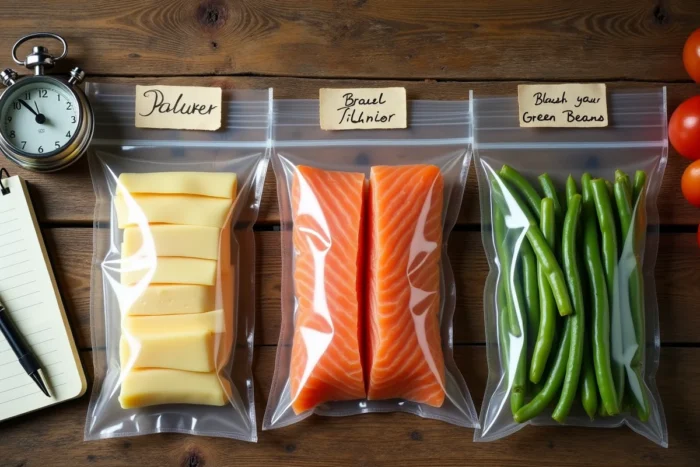
Freezing significantly alters the equation. At -18 °C, temperature fluctuations in a domestic freezer remain low compared to those in a refrigerator. Vacuum sealing combined with freezing multiplies the preservation duration by two to five depending on the food, and the gaps between theoretical and actual conditions are less pronounced.
The main risk in the freezer is not the temperature, but freezer burn. A poorly sealed or punctured bag exposes the food to cold, dry air, which dries out its surface. The quality of the bag is as important as that of the seal: a bag that is too thin (less than 90 microns) does not withstand prolonged cold well and may micro-crack.
Indicative Durations to Adjust
The tables often announce preservation durations in the freezer ranging from several months to over a year for certain vacuum-sealed meats. These figures remain generally reliable for a domestic freezer, provided that a thawed product is not refrozen and the integrity of the bag is checked before use.
For products whose texture degrades in the freezer (fatty fish, certain water-rich vegetables), a shorter preservation duration than the theoretical maximum better preserves taste qualities.
Adapting Theoretical Tables to One’s Own Use
The vacuum preservation tables remain a useful reference tool. Their limitation lies in the fact that they describe optimal conditions rarely replicated in a home kitchen. Three parameters allow for adjusting durations to one’s own situation:
- Check the effective temperature of your refrigerator with a dedicated thermometer, and adjust the thermostat if necessary
- Systematically check the seal and the absence of residual air in the bag after each vacuum sealing
- Apply a reduction of one quarter to one third on the stated durations for the most sensitive products (raw meats, fish, prepared dishes)
A vacuum-sealed bag that appears inflated, even slightly, indicates a loss of airtightness or the beginning of fermentation. In this case, the product should not be consumed, regardless of the theoretical preservation date. Observation remains the last line of defense, much more reliable than a number on a table.